
Today, we're happy to introduce vinyl-cutting engineer 'Diz', who played a key role in our recent Vinyl Drums 2 pack. Running 'Diz Lathe Cuts' out of Newcastle, UK, Diz provides dubplates, custom records and short runs for independent music artists who want their tracks on wax.
We enlisted his services to get a ton of our drum sounds pressed up, ready for us to re-sample via turntable to maximise that authentic grit that only vinyl can deliver.
To mark the release of Vinyl Drums 2 we caught up with Diz to find out more about the craft of lathe cutting and how he got into it.
MA: What is your background in music? What genres and styles are you into?
Diz: I grew up playing guitar and have worked in music for around 14 years, DJing nationally and internationally, running a radio station, working in record shops, promoting events, working in nightclubs and now cutting vinyl.
My taste is wide, but these days a lot of it is underground music rooted in gay and Black origins. I’m drawn to music with weight, texture, space, and history. Dub, disco, house, jungle, soul, ambient, leftfield club music, and anything with a strong sense of atmosphere.
I like music that feels physical. The kind of thing you feel in a room, through a sound system, not only through headphones.
MA: How did you get into lathe cutting? Presumably you’d been interested in vinyl from a listener’s, and maybe a DJ’s, perspective beforehand?
Diz: After collecting records for the best part of 15 years, vinyl was already a big part of my life as a listener and DJ. I’ve also always been technically minded, fixing and modifying my own equipment, from guitar pedals to turntables and speaker systems.
Lathe cutting came from wanting to understand records from the other side. Not just playing them, collecting them, or repairing the machines that play them, but learning how sound becomes a physical groove.
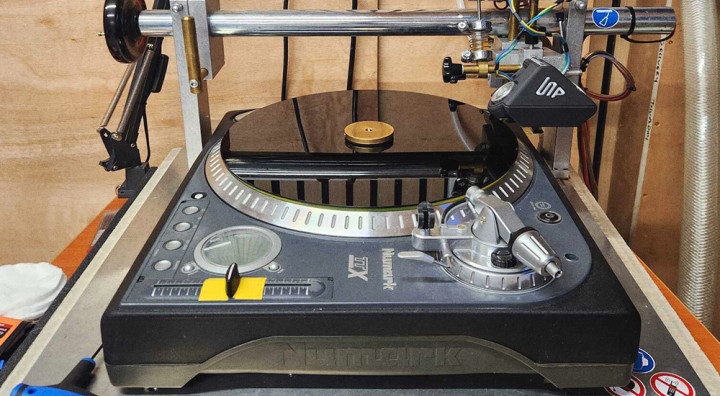
I went down a rabbit hole with the mysterious art of bringing a technical mindset to a truly artistic format. After a long few years trying to source a cutting lathe, I finally got my hands on one and built the best DIY rig I could from various parts.
At first it was curiosity. Then it became an obsession. You start realising how much is involved. The audio, the level, the groove spacing, the stylus heat, the blank temperature, the vacuum, the mechanics of the lathe. Every small change affects the result.
That hands-on nature is what pulled me in. It sits somewhere between music, engineering, and printmaking. You are making a record in real time, one cut at a time.
MA: The age old question, how important do you think playback medium is in the 21st century? What benefits do vinyl and turntables give you over streaming?
Diz: Streaming is useful. It gives access to almost everything, and that has value. But I don’t think access is the same thing as connection.
A record asks more from you. You choose it, handle it, put it on, listen to a side, turn it over. That changes the way you engage with the music. It slows the process down.
Vinyl also gives music a physical life. Artwork, labels, inserts, runouts, weight, surface noise, and wear all become part of the object. With streaming, music often becomes background content. With a record, it takes up space in your room and in your memory.
Turntables also reveal sound in a different way. They are mechanical systems. The cartridge, tonearm, platter, record, and speakers all shape the playback. That physical chain gives vinyl part of its character. It is not always about perfect accuracy. It is about experience, feel, and presence.
MA: Talk to us about the lathe cutting process itself, which seems a fascinating, intricate and deeply tactile procedure from the outside looking in.
Diz: Lathe cutting is the process of cutting a playable groove directly into a blank disc in real time.
With a pressed record, a factory makes metal stampers and presses copies from those. With lathe cuts, each record is individually cut one by one. The audio drives a cutting head, and the stylus carves the groove directly into the disc.
Before the cut, the audio has to be checked and prepared. Low end, stereo width, harsh top end, sibilance, and overall level all matter. Vinyl is physical, so you are not only asking “does this sound good?” You are asking “will this track cleanly as a groove?”
During the cut, you are managing a lot at once. The level, groove spacing, stylus heat, blank temperature, vacuum, swarf removal, and the movement of the cutting head across the disc. The waste material comes away as a fine thread while the groove is being cut, so the vacuum has to pull it away cleanly.
That is what makes it so tactile. You are watching and listening while the record is being made. There is no undo button. If something goes wrong, you cut another disc. It is slow, and mistakes slowly add up cost-wise, but that is also what gives the process its value.
MA: What would you expect the process of cutting our drum sounds to vinyl will give once we’ve re-sampled them, in terms of character?
Diz: Cutting drums to vinyl and then re-sampling them should give you a physical layer of colour that is hard to fake cleanly in the box.
The transients will usually round off a little. The top end may soften. The low end may feel a bit more glued together. Depending on the source and the cut level, you might get subtle saturation, groove movement, surface texture, and a bit of mechanical compression from the format.
It should make the drums feel less static. You are passing them through a physical process, with a stylus cutting a groove and a cartridge reading it back. That introduces small movements, tone shifts, and imperfections.
For drums, that can be a good thing. Kicks can feel more planted. Snares and hats can take on a bit of grit. Loops can feel more lived-in. It is not about making them lo-fi for the sake of it. It is about adding real-world movement and texture from the vinyl chain.
Check It Out
We'd like to thank Diz for his involvement in the project and taking the time to give us a fascinating insight into his craft. Make sure to check out the resulting vinyl-laced sounds inside Vinyl Drums 2 today!


